4.1. CHARACTERISTICS OF AN EMBEDDED SYSTEM
Some of the importance characteristics of embedded systems are:
- Application and domain specific
- Reactive and real time
- Operates in harsh environments
- Distributed
- Small size and weight
- Power concerns
Application and domain specific
- Each embedded system is having certain function to perform and they are developed in such a manner to do the intended functions only.
- They cannot be used for any other purpose. It is the major criterion which distinguishes an embedded system from a general-purpose system.
- For example, we cannot replace the embedded control unit of your micro oven with air conditioner’s embedded control unit, because the embedded control units of micro oven and air conditioner are specifically designed to perform certain specific tasks.
Reactive and real time
- Embedded systems are in constant system are in constant interaction with the real world through sensor and user-defined input devices which are connected to the input port of the system.
- Any changes happening in the real world is captured by the sensor input devices in real time and control algorithm running inside the unit reacts in a designed manner to bring the controlled output variables to the desired level.
- The event may be periodic or unpredicted one. If the event is unpredicted one then such a system should be designed in a such a way that, it should be scheduled to capture the events without missing them.
- Embedded systems produces changes in the output as changes in the input. So they are generally referred as Reactive systems.
- Real time system operation means the timing behavior of the system should be deterministic; meaning the system should respond to request or tasks in a known amount of time.
- A real time system should not miss any deadlines for tasks or operations. It is not necessary that all embedded systems should be real time in operations.
Operates in harsh environment
- The environment in which the embedded system deployed may be a dusty one or a high temperature zone or an area subject to vibrations and shock.
- System placed in such areas should be capable to withstand all these adverse operating conditions. The design should take care of the operating conditions of the area where the system is going to implement.
Distributed
- The term distributed means that embedded system may be a part of larger system. Many numbers of such distributed embedded system form a single large embedded control unit.
- An automatic vending machine is a typical example for this. The vending machine contains a card reader, a vending unit, etc. Each of them are independent embedded units but they work together to perform the overall Vending function.
Small size and weight
- Product aesthetic is another important factor in choosing a product.
Power concerns
- Power management is another important factor that needs to consider in designing embedded system.
- Embedded systems should be designed in such a way as to minimize the heat dissipation by the system.
- The product of high amount of heat demands cooling requirements like cooling fans which in turn occupies additional space and make the system bulky.
Quality attributes of embedded systems Operational quality attributes
The operational quality attributes represent the relevant quality attributes related to the embedded systems when it is in the operational mode or ‘online’ mode.
- Response
- Throughput
- Reliability
- Maintainability
- Security
- Safety
Response
- Response is a measure of quickness of the system. It gives an idea about how fast your system is tracking the changes in input variables.
- Most of the embedded system demand fast response which should be almost real time.
Throughput
- throughput deals with the efficiency of a system.
- it can be defined as the rate of production or operation of a defined process over a started period of time.
- The rates can be expressed in terms of units of products, batches produced, or any other meaningful measurements.
- Throughput is generally measured in terms of ‘BENHMARK’.
Reliability
- Reliability is a measure of how much % you can rely upon the proper functioning of the system or what is the % susceptibility of the system to failures.
- Mean time between failures (MTBF) and mean time to repair (MTTR) are the terms used in defining system reliability.
- MTBF gives the frequency of failures in hours/weeks/months.
- MTTR specifies how long the system is allowed to be out of order following a failure.
Maintainability
- maintainability deals with support and maintenance to the end user or client in case of technical issues and product failure or on the basis of a routine system check-up.
- Reliability and maintainability are considered as two complementary disciplines.
- A more reliable system means a system with less corrective maintainability requirements and vice versa.
- As the reliability of the system increases the chances of failure and non-functioning also reduces, thereby the need for maintainability is also reduced.
- Maintainability is closely related to the system availability.
Security
- ‘confidentiality’, ‘integrity’ and ‘availability’ are the three major measures of information security.
- Confidentiality deals with the protection of data and application from unauthorised disclosure.
- Integrity deals with the protection of data and application from unauthorized modification.
- Availability deals with protection data and application from authorized users a very good example of the security aspect in a embedded product is a Personal Digital assistant (PDA).
Safety
- Safety deals with the possible damage that can happen to the operators, public and the environment due to the breakdown of an embedded system or due to the emission of radioactive or hazardous material from the embedded products.
- Safety analysis is must in product engineering to evaluate the anticipated damages and determine the best course of action to bring down the consequences of the damages to an acceptable level.
Non-Operational Quality Attributes
The important quality attributes coming under this category are listed below.
- Testability & Debug-ability
- Evolvability
- Portability
- Time to prototype and market
- Per unit and total cost.
Testability & Debug-ability
- Testability deals with how easily one can test his/ her design.
- Application and by which means he/she can test it for an embedded products testability is applicable to both the embedded hardware and firmware
- hardware testing ensure that the peripheral and the total hardware functions in the desired manner
- firmware testing ensure that the firmware is functioning in the expected way
- debug ability is a means of debugging the product as such for figuring out the probable sources that creating the unexpected behaviour in the total system.
- Debug-ability has two aspects in the embedded system development context, namely, hardware level debugging and firmware level debugging
- hardware debugging is used for figuring out the issues created by hardware problems
- firm debugging is employed to figure out the probable errors that appear as a result of flaws in the firmware
Evolvability
- Evolvability referred as the non-heritable variation.
- For an embedded system, the quality attributes refers to the ease with which the embedded product (including firmware and hardware) can be modified to take advantage of new firmware or hardware technologies
Portability
- Portability is a measure of system independence.
- An embedded product is said to be portable if the product is capable of functioning; as such in various environments, target processors/controllers and embedded operating system
- the case with which embedded product can be ported on to a new platform is a direct measure of re-work require
- A standard embedded product should always be flexible and portable.
- In embedded products, the term ‘porting’ represents the migration of the embedded firmware write for one target processor (e. g Intel x86) to a different target processor (say Hitach1 8H3 professor)
- If the firmware is written in a high level language like ‘C’ with little target processor- specific function (operating system extensions or compiler specific utilities), it is very easy to port the firmware for the new processor by replacing those ‘target processor-specific functions’ with the ones for the new target processor and re-compiling the program for the new target processor specific settings.
- Re-compiling the program for the new target processor generates the new target processor- specific machine codes.
- If the firmware is written in Assembly Language for a particular family of processor (say x86 family), it will be very difficult to translate the assembly language instructions to the new target processor specific language and so the portability is poor.
- For example, applications developed using Microsoft technologies (e.g. Microsoft Visual Choosing Visual studio) is capable of running only on Microsoft platforms and will not function on other operating systems; whereas applications developed using ‘Java’ from Sun Microsystems works on any operating system that supports java standards.
Time-to-Prototype and Market
- Time-to-market is the time elapsed between the conceptualization of a product and the time at which the product is ready for selling (for commercial product) or use (for non- commercial product). The commercial embedded product market is highly competitive and time to market the product is a critical factor in the success of a commercial embedded product.
- There may be multiple players in the embedded industry who develop products of the same category (like mobile phone, portable media players, etc.).
- If you come up with a new design and if it takes long time to develop and market it, the competitor product may take advantage of it with their product. Also, embedded technology is one where rapid technology change is happening.
- If you start your design by making use of a new technology and if it takes long time to develop and market the product, by the time you market the product, the technology might superseded with a new technology.
- Product prototyping helps a lot in reducing time -to-market. never you have a product idea, you may not be certain about the feasibility of the idea is an informal kind of rapid development in which the important features of the product under consideration are development in which the important is also another critical factor.
- If the prototype is developed faster, the actual estimate can be brought down significantly
- In order to shorten the time to prototype, make use of all possible options like the use of off-the-shelf components, re-usable assets, etc.
Per Unit Cost and Revenue
- Cost is a factor which is closely monitored by both end user (those who buy the product) and product manufacturer (those who build the product).
- Cost is a highly sensitive factor for commercial products.
- Any failure to position the cost of a commercial product at nominal rate, may lead to the failure of e product in the market.
- Proper market study and cost benefit analysis should be carried out before taking a decision on the per -unit cost of the embedded products.
- From a designer/product development company perspective the ultimate aim of a product is to generate marginal profit. So the budget and total system cost should be properly balanced to provide a marginal profits
Product Life-cycle (PLC)
- Embedded product has a product life cycle which starts with the design and developments phase.
- The product idea generation, prototyping, definition, actual product design and development. Exponent are the activities carried out during this phase.
- During the design and development phase there is only investment and no returns once the product is ready to sell, it is introduced to the market. This stage is known as the Product Iteration stage.
- During the initial period the sales and revenues will be low. There won’t be much competition and the products sales and revenue increases with time the growth phase, the product grabs high market. The maturity phase, the growth and sales will be steady and the revenue reaches at its peak.
- The Product Retirement/Decline phase starts with the drop in sales volume, market share and revenue the/decline happens due to various reasons like competition from similar product with enhanced features or technology changes, etc.
- At some point of the decline stage, the manufacturer announces discontinuing of the product. The different stages of the embedded products life cycle-revenue, unit cost and profit in each stage-are represented in the following Product Life-cycle graph.
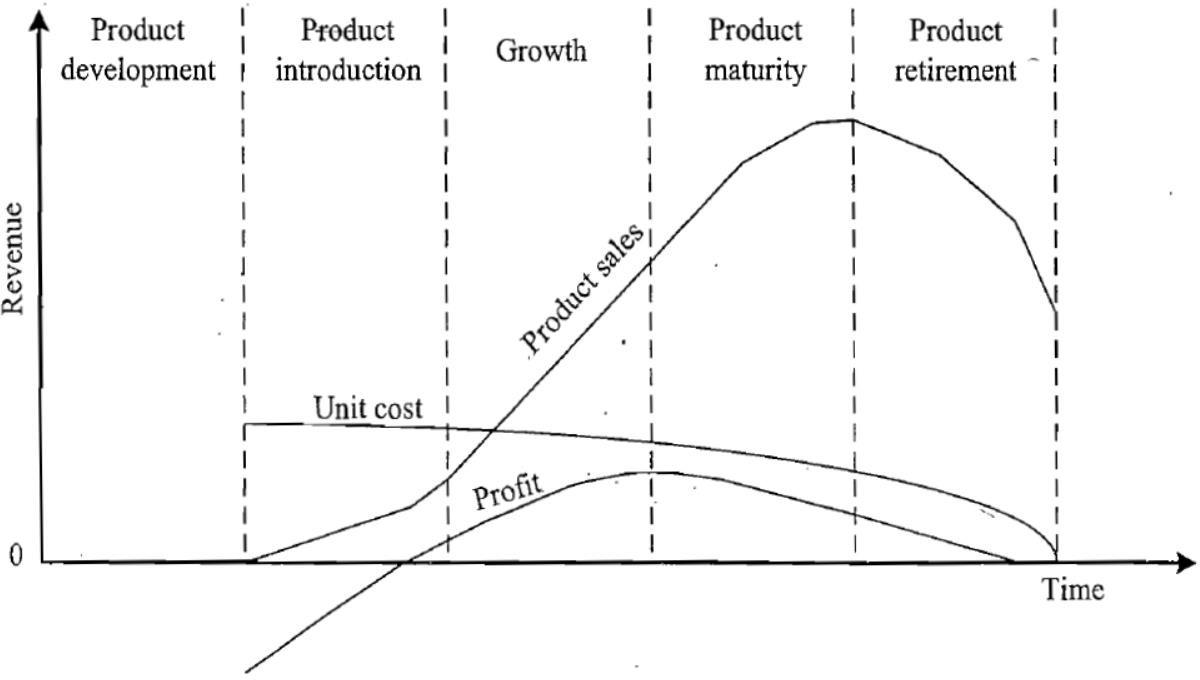
Product Life Cycle (PLC) curve
- From the graph, it is clear that the total revenue increases from the product introduction stage to the product maturity stage.
- The revenue peaks at the maturity stage and starts falling in the declined/retirement stage.
- The unit cost is very high during the Introductory stage (a typical example is cell phone if you buy a new model of cell phone during its launch time, the price will be high and you will get the same model with a very reduced price after three or four months of its launching).
- The profit increases with increase in sales and attains a steady value and then falls with a dip in sales.
- You can see a negative value for profit during the initial period. It is because during the product development phase there is only investment and no returns. Profit occurs only when the total returns exceed the investment and operating cost.
Keywords
Quality attributes: The nonfunctional requirements that need to be addressed in any system design
Reactive system: An embedded system which produces changes in output in response to the changes in input
Real-Time systems: A system which adheres to strict timing behaviour and rewards to requests in a known amount of time
Response: It is a measure of quickness of the system
Throughput: The rate of production or operation of a defined process over a stated period of time
Reliability: It is a measure of how much % one can rely on up on the proper functioning of the system.
EMBEDDED SYSTEMS -APPLICATION –AND DOMAIN-SPECIFIC
- Embedded systems are application and domain specific, meaning; they are specifically built for certain applications in certain domains like consumer electronics, telecom, automotive, industrial control, etc.
- In general purpose computing, it is possible to replace a system with another system which is closely matching with the existing system, whereas it is not the case with embedded systems, hence it is not possible to replace an embedded system developed for a specific application.
- Hence it is not possible to replace an embedded system developed for a specific application in a specific domain with another embedded system designed for some idea on the application and domain specific characteristics of embedded systems.
washing machine-application-specific embedded system
- washing machine is a typical example of an embedded system providing extensive support in home automation applications

- an embedded system contains sensors, actuator, control unit and application-specific user interfaces like keyboards, display units, etc.
- The actuator part of the washing machine consists of a motorized agitator, tumble tub, water drawing pump and inlet to consists of the water temperature sensor, level sensor, etc.
- The control part contains a micro-processor/controller-based board with interfaces to the sensors and actuators. The sensor data is fed back to the control unit and the control unit also provides connectivity to user interfaces like keypad for setting the washing time, selecting the type of be washed like light, medium, heavy duty, etc.
- User feedback is reflected through the display unit and LEDs connected to the control board. The functional block diagram of a washing machine is shown in Fig.
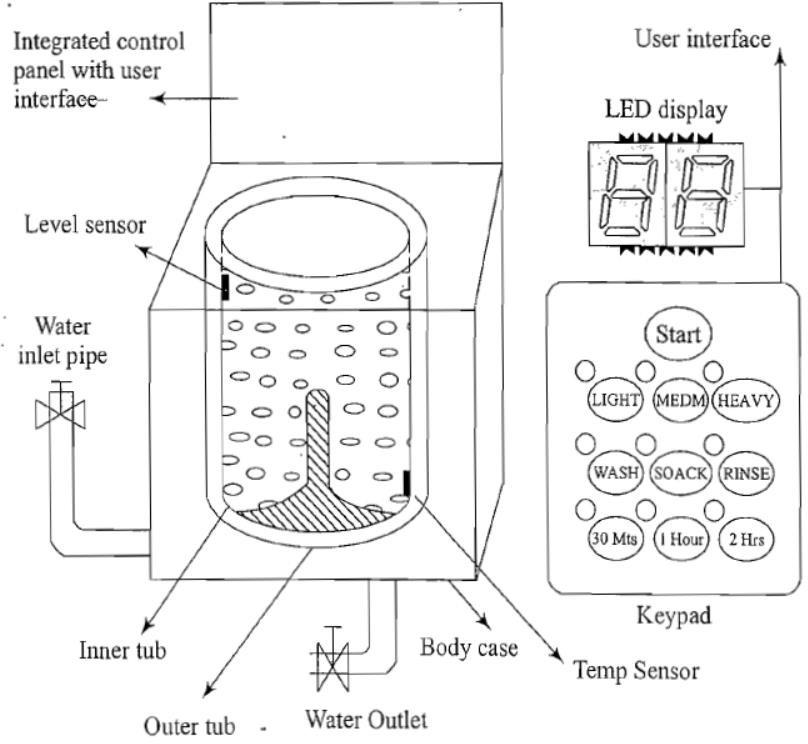
- Washing machine comes in two models, namely, top loading and front-loading machines
- In top loading models the agitator of the machine twists back and forth and pulls the cloth down to the bottom of the tub. On reaching the bottom of the tub clothes works their way back up to the top of the tub where the agitator grabs them again and repeats the mechanism.
- In the front-loading machines, the clothes are tumbled and plunged into the water over and again. This is the first phase of washing.
- In the second phase of washing, water is pumped out from the tub and the inner tub uses centrifugal force to wring out more water from the clothes by spinning at several hundred Rotations Per Minute (RPM). This is called a ‘Spin phase’.
- If you look in to the keyboard panel of your washing machines you can see three buttons namely Wash, Spin and Rinse. You can use these buttons to configure the washing stages.
- As you can see from the picture, the inner tub of the machine contains a number of holes and during the spin cycle the inner tub spins, and forces the water out through these holes to the stationary outer tub from which it is drained off through the outlet.
- It is to be noted that the design of washing machines may vary from manufacturer to manufacturer, but the general principle underlying in the working of the washing machine remains the same. The basic controls consist of a timer, cycle selector mechanism, water temperature selector, load size selector and start button. The mechanism includes the motor, transmission, clutch, pump, agitator, inner tub, outer tub and water inlet valve. Water inlet valve connects to the water supply line using at home and regulates the flow of water into the tub.
- The integrated control panel consists of a microprocessor/controller based board with I/O interfaces and a control algorithm running in it. Input interface includes the keyboard which consists of wash type selector namely Wash, Spin and Rinse, cloth type selector namely Light, Medium, Heavy duty and washing time setting, etc.
- The output interface consists of LED/LCD displays, status indication LEDs, etc. Connected to the I/O bus of the controller.
- It is to be noted that this interface may vary from manufacturer and model. The other types of I/O interfaces which are invisible to the end user are different kinds of sensor interfaces, namely, water temperature sensor, water level sensor, etc. and actuator interface including motor control for agitator and tub movement control, inlet water flow control, etc.
AUTOMOTIVE–DOMAIN-SPECIFIC EXAMPLES OF EMBEDDED SYSTEM
- The major application domains of embedded systems are consumer, industrial, automotive, telecom, etc., of which telecom and automotive industry holds a big market share.
- Figure give an overview of the various types of electronic control units employed in automotive applications.
Inner workings of automotive embedded systems
- Automotive embedded systems are the one where electronics take control over the mechanical systems.
- The presence of automotive embedded system in a vehicle varies from simple mirror and wiper controls to complex air bag controller and antilock brake systems (ABS).
- Automotive embedded systems are normally built around microcontroller or DSPs or a hybrid of the two and are generally known as Electronic Control Units (ECUs).
- The number of embedded controllers in an ordinary vehicle varies from 20 to 40 whereas a luxury vehicle like Mercedes S and BMW 7may content 75 to 100 numbers of embedded controllers. Government regulations on fuel economy. Environmental factors and emission standard and increasing customer demands on safety.
- Comfort and Infotainment forces the automotive manufactures to opt for sophisticated embedded control units within the vehicle.
- The first embedded system used in automotive application was the microprocessor-based fuel injection system introduced by Volkswagen 1600 In 1968.
- The various types of electronic control units (ECUs) used in the automotive embedded industry can be broadly classified into two-
→ High-speed embedded control units
→ Low-speed embedded control unit
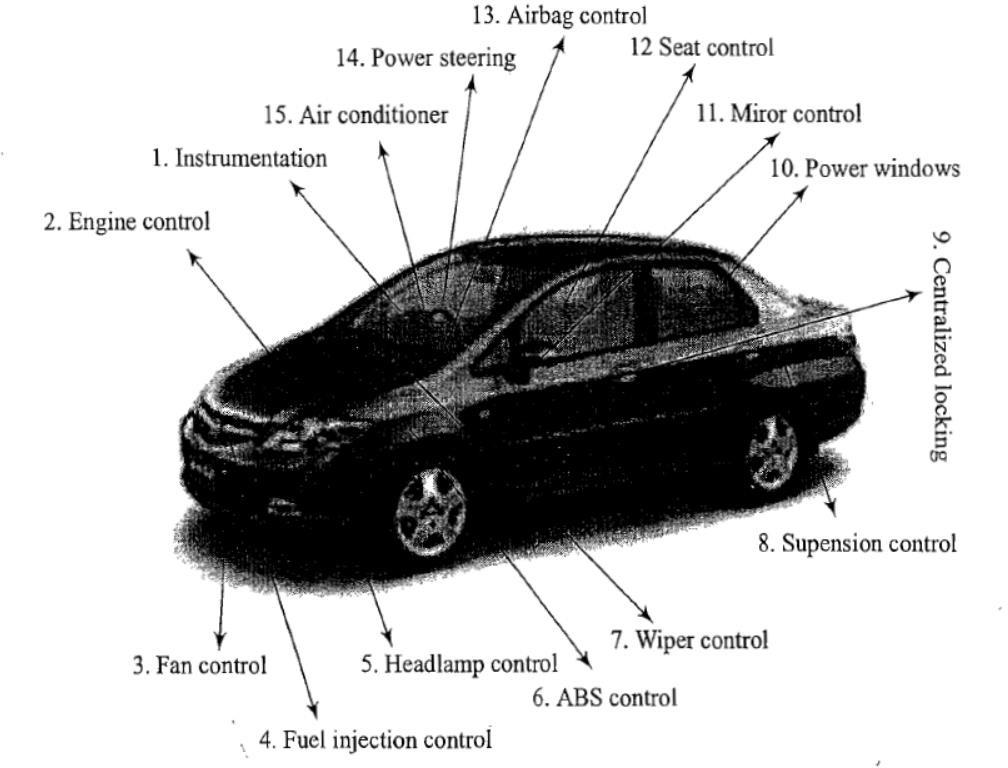
High-Speed Electronic Control Units (HECUs) High-speed electronic control units (HECUs) are deployed in critical control units requiring fast response. They include fuel injection systems, antilock brake systems, engine control, electronic throttle, steering controls, transmission control unit and central control unit.
Low-speed Electronic Control Unit (LECUs)Low-Speed Electronic Control Units (LECUs) are deployed in application where response time is not so critical. They generally are built around low microcontrollers/microprocessors and digital signal processors. Audio controllers, passenger and driver door locks, door glace controls (power windows), wiper control are examples of LECUs
Automotive Communication Buses
Automotive applications make use of serial buses for communication. Which greatly reduces the amount of wiring required inside a vehicle. The following are the different types of serial interface buses deployed in automotive embedded applications.
Controller Area Network (CAN) The CAN bus was originally proposed by Robert Bosch, pioneer in the Automotive embedded solution providers. It supports medium speed (1SO115l9- class B with data rates up to 125 Kbps) and high speed (ISO11898 class C with data rates up to 1Mbps) data transfer. CAN is an event-driven protocol interface with support for error
handling in data transmission. It is generally employed in safety system like airbag control; power train systems like engine control and Antilock Brake System (ABS); and navigation systems like GPS.
Local Interconnect Network (LIN) LIN bus is a single master multiple slave (up to 16 independent slave nodes) communication interface. LIN is a low speed. single Wire communication interface with support for data rates up to 20Kbps and is used for sensor/actuator interfacing. LIN bus follows the master communication triggering technique to eliminate the possible bus arbitration problem that can occur by the simultaneous talking of different slave nodes connected to a single interface bus. LIN bus is employed in applications like mirror controls, fan controls, seat positioning controls, window controls, and position controls where response time is not a critical issue.
Media-Oriented System Transport (MOST) Bus the Media-oriented system transport (MOST) is targeted for automotive audio/video equipment interfacing, used primarily in European cars. A MOST bus is a multimedia fibre-optic point-to-point network implemented in a star, ring or daisy- chained topology over optical fibre cables. The MOST bus specifications define the physical (electrical and optical parameters) layer as well as the application layer, network layer, and media access control. MOST bus is an optical fibre cable connected between the Electrical Optical Converter (EOC) and Optical Electrical Converter (OEC), which would translate into the optical cable MOST bus.
Key Players of the Automotive Embedded Market
The key players of the automotive embedded market can be visualized in three verticals namely, silicon providers, solution providers and tools and platform providers.
- Silicon Providers Silicon providers are responsible for providing the necessary chips which are used in the control application development. The chip maybe a standard product like microcontroller or DSP or ADC/DAG chips. Some applications may require specific chips and they are manufactured as Application Specific Integrated Chip (ASlC). The loading silicon providers in the automotive industry are:
Analog Device (www.analog.com): Provider of world class digital signal processing chips, precision analog microcontrollers. programmable inclinometer/accelerometer, LED drivers, etc. for automotive signal processing applications, driver assistance system, audio system, GPS/Navigation system etc.
Xilins (www.xilinx.com): Supplier of high-performance FPGAs, CPLDs and automotive specific IP cores for GPS navigation systems. driver information systems, distance control, collision avoidance, rear seat entertainment. adaptive cruise control, voice receptionist. etc.
Atmel (www.atmel.com): Supplier of cost-effective high-density Flash controllers and memories. Atmel provides a series of high-performance microcontrollers, namely, ARM1, ARM2, and 80C51. A wide range of Application Specific Standard Products (ASSPs) for chassis, body electronics, security, safety and car infotainment and automotive networking products for CAN, LIN and FlexRay are also supplied by Atmel.
Maxim/Dallas (www.maxim-ic.com): Supplier of world class analog, digital and mixed signal products (Microcontrollers, ADC/DAC, amplifiers, comparators, regulators, etc), RF components, etc. for all kinds of automotive solutions.
NXP semiconductor (www.nxp.com): Supplier of 8/16/32 Flash microcontrollers.
Renesas (www.renesas.com): Provider of high-speed microcontrollers and Large-Scale Integration (LSI) technology for car navigation systems accommodating three transfer speeds: high, medium and low.
Texas Instruments (www.ti.com): Supplier of microcontrollers, digital signal processors and automotive communication control chips for Local Inter Connect (LIN) bus products.
Fujitsu (www.fmal.fujitsu.com): Supplier of fingerprint sensors for security applications, graphic display controller for instrumentation application, AGPS/GPS for vehicle navigation system and different types of microcontrollers for automotive control applications.
Infineon (www.iniineon.com): Supplier of high-performance microcontrollers and customized application specific chips.
NEC (www.mec.co.jp): Provider of high-performance microcontrollers.
Tools and Platform Providers
Tools and platform providers are manufacturers and suppliers of various kinds of development tools and Real Time Embedded Operating Systems for developing and debugging different control unit related applications. Tools fall into two categories, namely embedded software application development tools and embedded hardware development tools. Sometimes the silicon suppliers provide the development suite for application development using their chip. Some third-party suppliers may also provide development kits and libraries. Some of the leading suppliers of tools and platforms in automotive embedded applications are listed below.
ENEA (www.cnea.com): ENEA Embedded Technology is the developer of the OSE Real- Time operating system. The OSE RTOS supports both CPU and DSP and has also been specially developed to support multi-core and fault-tolerant system development.
The Math Works (www.mathworks.com): It is the world's leading developer and supplier of technical software. It offers a wide range of tools, consultancy and training for numeric computation, visualization, modelling and simulation across many different industries. Math Work’s breakthrough product is MATLAB-a high-level programming language and environment for technical computation and numerical analysis. Together MATLAB, SIMULINK. State flow and Real-Time Workshop provide top quality tools for data analysis, test & measurement, application development and deployment, image processing and development of dynamic and reactive systems for DSP and control applications.
Keil Software (www.keil.com): The Integrated Development Environment Keil Micro vision from Keil software is a powerful embedded software design tool for 8051 & C166 family of microcontrollers.
Lauterbach (http://www.lauterbach.com/): It is the world’s number one supplier of debug tools, providing support for processors from multiple silicon vendors in the automotive market. ARTiSAN (www.artisansw.com): Is the leading supplier of collaborative modelling tools for requirement analysis, specification, design and development of complex applications.
Microsoft (www.microsoft.com)z It is a platform provider for automotive embedded applications. Microsoft’s WindowsCE is a powerful RTOS platform for automotive applications. Automotive features are included in the new WinCE Version for providing support for automotive application developers.
- Solution Providers Solution providers supply OEM and complete solution for automotive applications making use of the chips, platforms and different development tools. The major players of this domain are listed below.
Bosch Automotive (www.boschindia.com): Bosch is providing complete automotive solution ranging from body electronics, diesel engine control, gasoline engine control, powertrain systems, safety systems, in-car navigation systems and infotainment systems.
DENSO Automotive (www.globaldensoproducts.com): Denso is an Original Equipment Manufacturer (08M) and solution provider for engine management, climate control, body
electronics, driving control & safety, hybrid vehicles, embedded infotainment and communications.
Infosys Technologies (WWW. infosys. com): Infosys is a solution provider for automotive embedded hardware and software Infosys provides the competitive edge in integrating technology change through cost effective solutions.
Delphi (www.delphi.com): Delphi is the complete solution provider for engine control, safety, infotainment, etc., and OEM for spark plugs, bearings, etc